


K 2025 trade fair for plastics & rubber: WACKER starts serial production of flexible sensor electronics
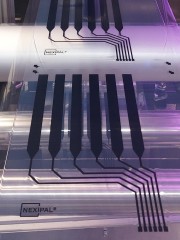
With the serial production of sensor laminates, the WACKER group is taking the production of flexible printed electronics to the next level. At this year’s K 2025 trade fair, held in Düsseldorf, Germany, from October 8 to 15, the company will be presenting itself as a manufacturer of prefabricated components for the first time. The laminates which are offered under the brand name NEXIPAL® Sense are produced using a specially developed and fully automated roll-to-roll manufacturing process.
NEXIPAL® Sense consists of highly stretchable insulating and electrically conductive silicone rubber films. The laminate, a stack of film layers, jointly works as a flexible and stretchable capacitor. Pressure or flex movements change the electrical capacitance of the component. Different capacity states thus provide precise sensor signals for applications in medical technology, robotics and sports.
By initiating the serial production of NEXIPAL® Sense laminates, WACKER is setting new standards in the world of flexible electronics. The Group no longer acts a mere material supplier, but is now able to offer prefabricated components – customized and ready for mass production and integration.
WACKER’s silicone laminates typically consist of layers – each with a film thickness of between 20 to 200 microns. The thickness of a human hair, by comparison, is roughly 50 microns. The addition-curing silicone rubber laminates are characterized by their exceptional elasticity, dimensional stability and toughness. They are skin-friendly, biocompatible, UV-resistant, and can withstand temperatures from 40 °C to +180 °C. Even after millions of load cycles, they retain their high degree of recovery and elasticity – clearly a major advantage over conventional materials.
The structured layers – consisting of specially developed electrically conductive silicones – are composed using digital laser printing techniques. With a resulting pixel size of just 100 microns, very fine electrode geometries are possible. “The flexibility and scalability we offer today is unique on the market,” explains Senior Business Development Manager Johannes Neuwirth. In merely a matter of seconds, designs can be changed directly within the process itself. The size, shape or number of layers can also be easily changed at the touch of a button and their configuration can be customized freely – from prototypes to batches of millions. In-line quality controls with AI-assisted image
processing ensure the consistent precision of each and every layer, i.e., ±5 microns accuracy in layer thickness.
“Our high-performance sensor laminates are performant, durable and sustainably produced at the highest level,” underlines Neuwirth. Serial production near WACKER’s production plant near Burghausen, Germany, uses electricity generated by the company’s own photovoltaic system. The entire production process is carried out at low temperatures. Neither rare earths nor solvents or
heavy metals are involved.
At K 2025 in Düsseldorf, the company will present an interactive exhibit for handson testing of the sensor laminates. And that is not all. The company is already looking into the future: NEXIPAL® Act, an actuator version of the laminate, is set to go into serial production in 2026. These silicone laminates deform and thus create movement precisely, smoothly and silently when an electrical voltage is applied. This makes them just as suitable as sensor laminates for a wide range of applications involving human-machine communication, for example, robotics, automotive or medical technology.
Visit WACKER at K 2025 in Hall 6, Booth A10, from October 8 to 15.