


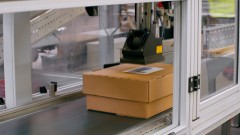
DHL adopts InNo-Liner solution from cab and HERMA
Shipping labels without liner material or silicone coating offer a sustainability advantage that has also convinced a leading logistics provider like DHL. At its site in Nohra, Thuringia, Germany, the company has now switched from conventional self-adhesive labels to a joint InNo-Liner solution from cab and HERMA. “It enables us to reduce waste by roughly 60 percent, simply because the silicone-coated liner is eliminated and we gain flexibility in label sizes,” says Aiste Slabokaite Heid, Business Unit Director North-East DHL Supply Chain Germany & Alps. “The system also helps us cut costs: It is about 40 percent more economical than conventional labeling systems.” The Nohra facility specializes in supplying more than 25,000 internal customers of Deutsche Post across Germany. “Our job is to supply each department according to its specific needs—from pens and copy paper to bicycle spare parts, essentially everything required internally to keep the postal service running,” explains Marco Sawall, Head of the Central Post Warehouse at DHL in Nohra. On 13,000 square meters of warehouse space, more than 4,000 different products are available every day. “Most of the items ordered are shipped in cartons—and for that we need a very large number of labels; up to now, these were always labels on a silicone-coated liner.” Approximately 750,000 labeled shipping cartons leave the logistics center each year. “Because we use so many labels in logistics and warehousing, labeling is a major topic for us,” emphasizes Slabokaite Heid. “We have ambitious sustainability goals and rely on innovative logistics solutions to achieve them.”
“Switching is very easy”
What convinced DHL’s logistics experts is a system solution consisting of two components: the award-winning InNo-Liner material from HERMA and a further development of cab’s HERMES Q print-and-apply system. “For InNo-Liner labels, we only had to create a new module to activate the adhesive and apply the labels,” explains Clément Kleinclauss, Managing Director of cab France. “Switching is therefore very easy. And for our existing customers who already use the HERMES Q and the jscript printer language, it hardly requires any change at all.” Alexander Bardutzky, CEO of cab, adds: “With the HERMES QL, a single system can handle three types of pressure-sensitive material: InNo-Liner, conventional linerless, and—if required—traditional self-adhesive labels.” HERMA Managing Director Dr. Guido Spachtholz highlights the decisive difference: “With InNo-Liner, the material does not stick when wound. Because it can be wound onto itself without silicone, it can also be freely printed.”
“There is no better system for the future”
For InNo-Liner material, the HERMES Q is equipped with a special activation unit. “It uses multi-nozzle technology that activates the adhesive during application with a fine water mist,” explains Sven Pleier, Key Account Manager at HERMA. “This ensures immediate adhesion on absorbent surfaces and allows the label to reach its full bond strength within a very short time. The project in Nohra has demonstrated that the system performs reliably even under high demands for labeling quality and cycle time.” Aiste Slabokaite Heid from DHL confirms this: “Companies that have not yet worked with InNo-Liner should give it a try—the results are convincing in two ways: It helps us meet our sustainability goals and reduce costs. Our customers are also pleased with the outcome.” Her colleague Marco Sawall sums it up clearly: “For me, there are four measurable benefits: zero grams of silicone liner waste, optimal use of each label down to the last centimeter, setup time below one minute, and no waste at all. Anyone is welcome to come see it. For the future, there is no better system than moving away from silicone liner bands.”